
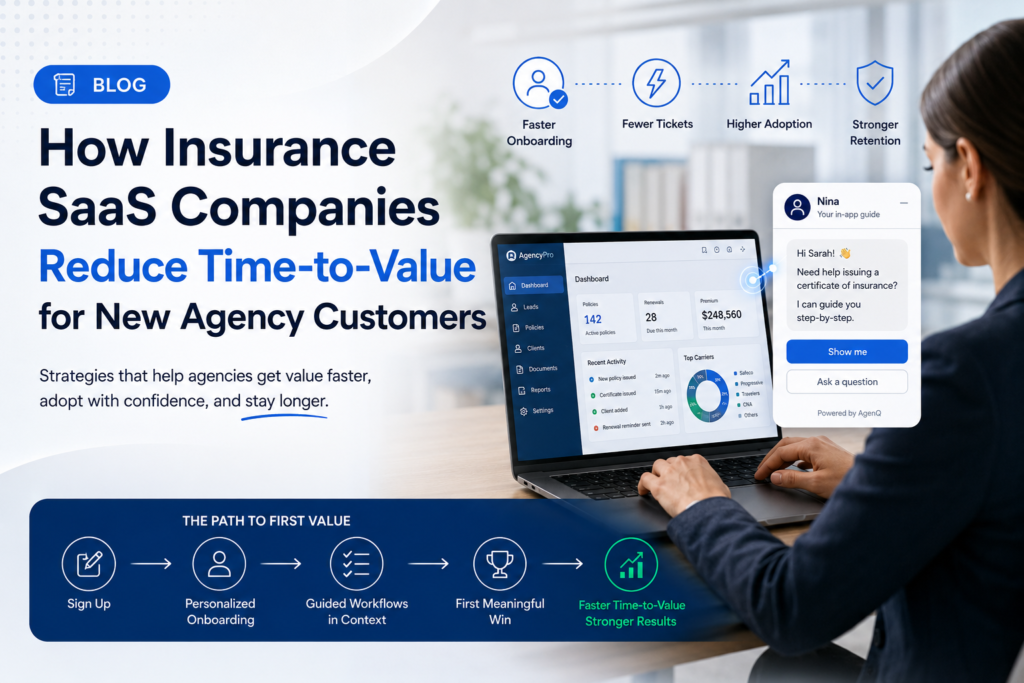
How Insurance SaaS Companies Reduce Time-to-Value for New Agency Customers
Insurance SaaS companies reduce time-to-value for new agency customers by collapsing the gap between account activation and the first meaningful workflow win — replacing front-loaded training programs with role-specific in-app guidance, progressive feature disclosure, and contextual Q&A that meets agents where they are in the product. The biggest lever is not a better help center; it is getting the right guidance to the right person at the exact moment they are about to get lost, which is what separates products that agencies adopt from products that agencies resent.
Key takeaways:
- The FinTech and Insurance category has one of the lowest user activation rates in B2B SaaS — just 5%, versus a cross-industry average of 37.5%, according to Userpilot’s 2024 benchmark of 62 companies.
- About 26% of insurance agencies report prolonged onboarding timelines specifically because of data migration complexity, per Global Growth Insights’ insurance software market analysis.
- Cutting time-to-value by 20% has been linked to an 18% lift in ARR growth for mid-market SaaS companies, per a 2024 Amplitude study.
- A Pendo survey found that 80% of respondents believe better in-app guidance would help them get more value from the software they use.
- 43% of all SMB customer losses happen in the first 90 days post-purchase — making the onboarding window the single highest-leverage period for insurance SaaS retention, according to Focus Digital’s 2025 churn analysis.
—
Why is insurance SaaS onboarding so much harder than other verticals?
Most SaaS onboarding complexity comes from features. Insurance SaaS onboarding complexity comes from the world the product lives in — and those are two completely different problems.
A new agency user is not just learning software. They are simultaneously navigating state licensing requirements, carrier appointment processes that can take 30 to 60 days per carrier, E&O documentation rules, compliance workflows, and a customer-facing service obligation that does not pause while they figure out the platform. AMS training alone can consume two to three weeks of a new hire’s ramp-up period, according to research published by Sonant AI. That is not a UI problem. That is a domain problem wearing a UI problem’s clothes.
The result is predictable. Userpilot’s 2024 benchmark data shows FinTech and Insurance products activating at just 5% — the lowest category in the study by a wide margin. The cross-industry B2B SaaS average sits at 37.5%. That spread exists because most insurance platforms design for the power user who has been in the industry for a decade, not for the CSR who just passed their licensing exam and logged in for the first time at 8:47 AM on a Monday.
Admin-heavy means the path to first value is long by default. Policy lifecycle management, document automation, renewal tracking, quoting, compliance reporting — these are not features you demo in 10 minutes. They are workflows that require context, judgment, and hands-on repetition. Every step that is unclear is a moment where an agency staff member stops, googles something, interrupts a colleague, opens a support ticket, or quietly decides the product is not worth the effort.
Time-to-value (TTV) means the elapsed time between a customer signing up and that customer experiencing the specific outcome they paid for — not the time they finish a checklist. Those are two different things, and conflating them is where most insurance SaaS teams go wrong.
—
What does “reducing time-to-value” actually mean for a complex insurance product?
It does not mean making the product simpler. It means making complexity survivable.
There is a tempting but wrong answer here: strip features to reduce cognitive load. A claims management system that cannot handle the edge cases is not a simpler product — it is a weaker one. Agencies buy insurance software precisely because their workflows are complicated. The goal is not simplicity; it is guided complexity.
Reducing TTV for an insurance SaaS product means three things in practice:
First, define a real first-value event. Not “completed setup.” Not “logged in twice.” An actual, observable moment where an agency user has done something that mirrors the work they were sold on — run a quote, issued a certificate, tracked a renewal, generated a compliance report. Most teams have never defined this precisely enough to measure it, which is why TTV stays a concept rather than a metric.
Second, build the path to that event around the user’s role. A producer and a CSR and an agency owner all have different jobs in the same platform. Progressive disclosure means showing each persona only what they need to accomplish their first win, then expanding from there. According to research cited by UserGuiding, personalized onboarding increases activation rates by 30 to 50% compared to generic, one-size-fits-all approaches.
Third, answer questions at the point of confusion, not the point of inquiry. This is the distinction between a knowledge base and an embedded AI training assistant. A knowledge base requires a user to know they have a question, leave the workflow, search for an answer, translate the answer into their context, and come back. An embedded AI training assistant surfaces the answer inside the workflow, triggered by the user’s actual behavior, without requiring any of that cognitive overhead.
AgenQ is an AI assistant embedded in B2B SaaS products for guided training and contextual Q&A. That category — embedded AI training assistant — matters because the delivery mechanism changes what users actually do with the help they receive. Help you have to hunt for does not reduce TTV. Help that finds you does.
—
Why do agencies abandon insurance software before it ever delivers value?
The abandonment data is uncomfortable. According to UserGuiding’s 2025 research, users who do not engage within the first three days have a 90% chance of churning. According to Amplitude’s 2025 benchmark across more than 2,600 companies, over 98% of new users churn within two weeks when they never hit a value milestone.
For insurance agencies, the specific failure modes look like this:
Data migration paralysis. About 26% of agencies report prolonged onboarding timelines specifically because of data migration complexity, according to Global Growth Insights. When an agency cannot get its existing book of business into the platform cleanly, the product is useless. No amount of feature polish fixes this.
Training debt. New hires at insurance agencies often churn before they become productive. According to LeadSquared, over 90% of insurance agents quit within the first year — and the burnout rate during that period is higher than most other occupations. When AMS software training itself takes weeks, it compounds an already fragile retention situation.
Role mismatch in onboarding. A generic product tour that walks every user through the same screens ignores the fact that the person who handles renewals and the person who manages E&O documentation have almost nothing in common in their daily workflow. Generic onboarding creates confusion that looks like disengagement in the analytics.
Support lag. When agents hit a wall and cannot get a fast answer, they stop. According to Zendesk’s 2025 benchmark, a 15% rise in assisted resolutions — meaning users getting answers from AI or self-help rather than waiting for a human — links to an 11% drop in churn. That causation is direct and measurable.
—
What specific tactics work for reducing time-to-value in insurance SaaS?
Role-gated onboarding flows. On signup or first login, capture the user’s role — producer, CSR, owner, compliance officer. Then route them to a condensed path that reaches their first win in the fewest possible steps. Research from Nielsen Norman Group shows a 30 to 45% improvement in task completion when contextual guidance is present versus absent.
Milestone-based feature unlocking. Hide the full feature surface until users earn access by completing foundational tasks. This is not gatekeeping — it is cognitive protection. Every additional onboarding step that is not necessary increases abandonment risk. According to Appcues research cited by GetMonetizely, reducing onboarding steps by 30% increases completion rates by up to 50%.
Embedded, contextual Q&A. The shift that matters is from help-on-demand to help-in-context. An embedded AI training assistant that understands where a user is in the product and what they are trying to do can answer “how do I attach a certificate of insurance to this account” without requiring the user to leave the workflow, open a tab, and search a knowledge base. This matters especially in insurance, where compliance-adjacent workflows are unforgiving and a wrong step has real consequences.
Behavioral triggers over scheduled emails. Contextual messages achieve 4.5x higher engagement rates compared to scheduled broadcast messages, according to Intercom research on customer engagement. Telling a new user via email that they should try the renewal tracking feature on Day 7 is not as effective as triggering a tooltip when they first hover over the renewals screen.
Dedicated migration support in the first 14 days. Given that data migration complexity is a top onboarding blocker for insurance agencies specifically, SaaS teams that front-load migration assistance — not just documentation, but human-assisted data import and validation — dramatically reduce the pre-value dead zone.
—
How does an embedded AI training assistant specifically help insurance SaaS products?
In-app guidance means instructional content delivered inside the product interface that helps users navigate features, complete tasks, or discover new value. The embedded AI training assistant is the evolved form of this: it does not just guide users through predefined paths, it responds to what the user is actually asking, in the context of what they are actually doing.
For insurance SaaS, this has specific advantages that generic B2B products do not need as badly:
Compliance workflow reinforcement. Insurance workflows have mandatory sequences — specific documentation, approvals, audit trails. An embedded AI training assistant can prompt users to complete required steps without requiring them to know they missed one.
Multi-role concurrent onboarding. An agency that goes live on a new platform often has 5 to 15 users who need to be functional within 30 days. Scaling human training to that volume without destroying the customer success team’s bandwidth requires something that can answer “why do I see a red flag on this policy” at 3 PM on a Thursday without a human in the loop.
Support ticket deflection. According to Product Fruits’ analysis, digital adoption platforms that include in-app guidance reduce support ticket volume by 30% even before AI-native capabilities are layered in. With AI-based contextual Q&A, the reduction in human-handled support cases is often 50% or more.
The business case for this is not subtle. Gainsight data cited by GetMonetizely shows that customers who complete onboarding are 30% more likely to purchase additional services. A shorter TTV does not just prevent churn — it creates the conditions for expansion revenue.